Friday, June 30, 2006

The Blogosphere For Sale

A new service called PayPerPost.com matches bloggers with companies who will pay them to blog about a product:

Murphy, who founded a Tampa-based interactive ad agency called MindComet, also runs a side business that pays bloggers to write nice things about corporate sponsors -- without unduly worrying about whether or not bloggers disclose these arrangements to readers. (A scan of relevant blog searches strongly suggests that, often, they don't.) (BusinessWeek)

I agree with Pete Cashmore's take on this “service”:

PayPerPost is a great new way to lose your credibility as a blogger - the service will pay you to write reviews of new products and services. Advertisers post “opportunities” on the site - they can specify whether the post should have pictures, and even request a positive review. That last part really crosses the line, and it’s sure to destroy any credibility you have as a writer. ... PayPerPost is a terrible, terrible idea and totally unethical. (Mashable)

Even TechCrunch is weighing in with an opinion with a post titled, 'PayPerPost.com offers to sell your soul':

Is this a bad joke designed to torpedo the blogosphere’s credibility in general? It doesn’t appear to be. If we’re all trying to negotiate a space between Hollywood and mainstream journalism, this is taking things way too far towards the most insipid parts of Hollywood.

Clearly comfortable with the “all press is good press” paradigm, Murphy is emailing bloggers with a link to scathing coverage at Business Week (”Polluting the Blogosphere“) and even includes the words “As seen in Business Week” in the company logo. (TechCrunch)

I think that many of us would agree that the people who take money from companies to say nice things about a product without disclosing the relationship are those at the bottom of the blogosphere barrel (where all the yucky stuff accumulates). Like many other bloggers, I take it seriously. I spend time researching and thinking about what I write, and I would never write something I did not believe or otherwise allow someone else to dictate what I can or cannot say (paid or otherwise). Needless to say, not everyone has these standards, and like any other medium, the reader has to keep the source in mind. I will pay much more attention to something that I read in TechCrunch over something on some random person's blog the same way that I would be more likely to believe something in the Wall Street Journal over something that I saw in a banner ad on the web. The difficulty with this situation is that the banner ad can be made to look like the Wall Street Journal with paid content bloggers masquerading as respectable sources of information.

Tuesday, June 27, 2006

Is It too Late for Sun?

Sun says that an open source Java will be released within “months”:

A Sun Microsystems Inc. executive said Tuesday said the company is “months” away from releasing its trademark Java programming language under an open-source license.

Simon Phipps, chief open-source officer for Sun, said the company is ruminating over two major issues: how to keep Java compatible and ensure no particular company uses market forces as muscle for its own implementation, a move that would threaten Java's "write once, run anywhere" mantra. ...

Sun announced in May it would release an open-source version of Java, about one month after Jonathan Schwartz replaced Scott McNealy as chief executive officer. The leadership change pushed the issue of whether to open source Java to how to make the transition, Phipps said. (InfoWorld)

People have been calling for Sun to open source Java for quite some time with Peter Yared, ActiveGrid CEO, being one of the most vocal. Customers, partners, and community members have been dragging Sun kicking and screaming to the open source Java party, but for the most part Sun is just late to the game:

Many observers say Sun's moves are late, as Microsoft Corp. has gained ground with its own .NET and C# programming languages.

Brian Behlendorf, co-founder of the Apache Web Server Project, said Sun and Java would have benefited earlier from distributed debugging and innovation plus a better reputation for reliability, especially on the server side.

"I think had they done it, they would have established Java further as the language of choice by so many more people," Behlendorf said.

One area that will need to change is the Java Community Process (JCP), whereby Java standards are set, a prominent free software developer said.

The JCP is too secretive and restrictive, said Dalibor Topic, who leads the Kaffe project, which has been working for years on an open-source version of Java.

"I do not value spending my time wrestling with Sun's legal department to find out if I can talk about something with my peers," he wrote in an e-mail, soon after Sun announced plans to open source Java.

Sun's talk of delivering an open-source version of Java ignores that fact that open-source Java runtimes and compatibility test suites already exist, he said.

"Basically, we've already come 90 percent of the way towards having several full, compatible, free software Java 1.5 implementations, without Sun's support," Topic said. "I don't think that Sun would like to promote the message that open source Java has, for the most part, already been done, without them contributing." (InfoWorld)

Danese Cooper suggests keeping an eye on Harmony, which the Linux distributors can ship pre-installed, while Sun's JRE is relegated to a less accessible “non-free” directory.

All of this leads me to wonder whether Sun is just too late to the party. There will certainly be much rejoicing among the open source and Java communities when Java is finally released into open source, but at the end of the day how much will really change as a result of it?

read more | digg story

Monday, June 26, 2006

Are Podcasts an Efficient Use of Time?

I admit to being a podcast addict, but many people are still trying to figure out when or if they should even be listening to podcasts. Peter Davis is questioning whether or not listening to podcasts is an efficient use of his time when he can get information more quickly by reading it. I tend to agree with Scoble; you can get the information more quickly by reading it, but podcasts are great for when reading is impractical.

I have managed to incorporate podcasting into a variety of strange places in my daily routine. I start the day by downloading podcasts from my computer while I make my morning pot of green tea. I listen to the morning news podcasts while I get ready for work (usually the NPR 7am News Summary, the NYT Front Page, and the WSJ AM Tech News Update). On my 10 minute drive to work and while getting my computer booted, I can usually listen to at least part of another podcast (this morning I caught a few minutes of the latest TWIT). Before I leave work in the evening, I download another batch for the evening.

I listen to podcasts while I cook dinner, wash dishes, empty the dishwasher, fold laundry, do yard work (way too rarely), grocery shop, work out, and anything else that involves more than a few minutes of time away from the computer.

Unlike the radio or TV, I have more control over what I download and when I listed to it. Podcasts have not replaced my reading of blogs, but they have replaced quite a bit of the time that I used to spend reading the news. Podcasts have made me significantly more productive because I can now get my news at times that would have otherwise been wasted time.

A few of my other podcast favorites:

Friday, June 23, 2006

Open Source Gets Boring

As open source gets more mainstream and more popular, whether your software is open source becomes less of an issue and more of a so what. In the early 1990s, if you told someone that you were going to run your business on open source software, they would have laughed you out of the room ... assuming that they even knew what open source software was. Linux was a “toy” operating system and open source software was something for universities and crazy people. Those of us who were sys admins / network admins at the time would have quietly chuckled knowing that the company's infrastructure was already running on open source software (BIND, etc.), but management did not need to know that little tidbit of information.

Fast forward a few years into the future around the time of the dot-com era when the early adopter companies began taking open source seriously and using open source software in increasingly important areas of their businesses. At this point, if you told someone that you were going to run your business on open source software, they would have mostly questions. Are you sure that is a good idea? Is it stable? Does it work? How hard was it to train people to use the software? Where do you get support, and is the support any good?

Today most companies are comfortable using open source software, especially in the lower software layers in the stack (application development / deployment, middleware, databases, etc.) Companies are picking solutions that meets their needs using combinations of proprietary and open source software. Occasionally people may still question a decision to run open source software in a particularly mission critical environment despite the fact that big sites like Amazon.com and Travelocity use Linux, MySQL, and other open source software to run the most critical parts of their businesses.

I read an interesting article today that got me started thinking about this topic. Executives from SpikeSource, JBoss, Sun, and EnterpriseDB debated on a variety of topics at The Open Source Effect event. Andy Astor, CEO of EnterpriseDB said that “open source will become part of the fabric of IT deployments the way client-server is now, Astor said. 'Open source is going to be a big yawn in five years,' he said.” (InfoWorld). This is what will eventually move open source into the "so what" camp. By “so what”, I do not mean that no one will care about open source software. I do think that choosing open source software will cease to become an issue. The decision to move to open source software will be based on the requirements and the business need unencumbered by current or past misconceptions about open source.

Digg, an Open Community Success Story

With the launch of Digg 3.0 only a few days away, Digg has been generating a ton of news. I started using Digg back in November and have found it to be a great way to get the very latest tech news. Even before stories hit the home page, I find myself scouring the Digg for Stories Cloud View for recently submitted stories that are moving up the queue toward the front page.

The stats are amazing. According to TechCrunch:

“Digg is looking more and more like the newspaper of the web, and is challenging even the New York Times on page views (Digg surpassed rival Slashdot long ago).

About 800,000 unique visitors come to Digg every day, generating 9 million plus page views. The site is doubling in traffic every two months. And the amazing thing is that Digg does all of this with just 15 employees.” (TechCrunch)

The reason that they can do this with only 15 employees is because they effectively utilize an active and open user community. There are no editors on Digg. Users submit the stories and the community selects which stories are promoted to the front page by digging interesting stories (essentially voting on them). Users can also comment on the stories and rate the comments of others thus providing an active commentary and additional opinions on any story. The community is also self-policing to some degree. Any story can be flagged by a user as inaccurate or as spam, and there are additional people and algorithms at work on the back end at Digg to identify anyone using false account or bots to artificially promote a story to the home page.

The above stats are particularly amazing when you consider that Digg only covers technology news. This brings us to the news of the Digg 3.0 launch. Digg will be redesigned, and in addition to technology, they will add categories for entertainment, gaming, science, world & business, and online video. Some people are skeptical about whether or not Digg will be successful in other categories:

“Digg users will still be sitting in comfy chairs while other people put on body armor to report from war zones. Digg (and every news filter for that matter) is a leech on every news gatherer, from blogger journalists to institutional journalists.” (Publishing 2.0)

This misses the point. First, Digg is a global community where people living in “war zones” can participate. Second, Digg is not a leech on news gatherers; Digg helps provide visibility for stories that might not get noticed otherwise. Over the past year, a number of stories have gained momentum on Digg before they hit the traditional press.

Digg is not without faults. Sometimes the sensationalist and the bizarre are promoted to the front page over stories that seem more newsworthy (in my humble opinion), and the comments can get pretty nasty at times (this has improved tremendously now that we can vote on user comments!) Despite the flaws, I am looking forward to the Digg 3.0 launch.

Tuesday, June 20, 2006

Responsibility for Online Dangers

In our litigious society here in the United States, it was bound to happen sooner or later. MySpace is being sued because it failed to protect a minor from a sexual predator:

"A 14-year-old Travis County girl who said she was sexually assaulted by a Buda man she met on MySpace.com sued the popular social networking site Monday for $30 million, claiming that it fails to protect minors from adult sexual predators.

The lawsuit claims that the Web site does not require users to verify their age and calls the security measures aimed at preventing strangers from contacting users younger than 16 'utterly ineffective.'

Solis contacted the girl through her MySpace Web site in April, telling her that he was a high school senior who played on the football team, according to the lawsuit.

In May, after a series of e-mails and phone calls, he picked her up at school, took her out to eat and to a movie, then drove her to an apartment complex parking lot in South Austin, where he sexually assaulted her, police said. He was arrested May 19." (The Statesman)

Let me see if I understand this. A fourteen year-old girl meets someone she does not know online, goes on a date with him, something terrible happens, and somehow this is MySpace's fault? Interesting logic.

This is the same logic that led to the McDonald's suit when a woman burned herself by spilling hot coffee in her lap. I agree with Mike at TechDirt:

"Clearly, the 19-year-old was at fault here -- and has been arrested for his actions. To then go on and sue MySpace is ridiculous. Do people sue the phone company for facilitating sexual assault when it happens over the phone? Or the ISP when it happens over email? This is just a blatant attempt to cash in on an unfortunate situation." (TechDirt)

At fourteen, I would never have been allowed to get into a car with some guy. I know that parents cannot keep a 24x7 watch on their kids; however, parents do need to take responsibility for educating their children about the dangers in this world (both offline and online dangers) allowing their children to make smart choices. It is terrible that something like this happened to such a young girl; however, the responsibility for ensuring safety does not lie with MySpace. If this incident happened at a mall or a school, like many of them do, the mall or school should not accused of "failing to protect minors from sexual predators" and should not be held responsible for the actions of other people.

Sunday, June 18, 2006

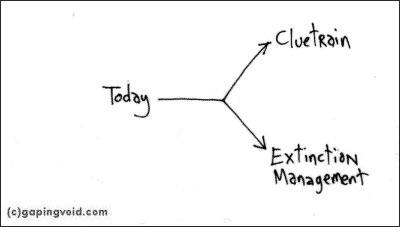
Get a Clue or Become Extinct

The world is changing (or has changed) in a way that can no longer be ignored. For those of us working in the technology industry, it is easy to get swept into the web 2.0 world to the point where the changes seem so obvious. Communities, open source software, user contribution, participation, blogging, podcasting … are part of the way business works in today's environment. Traditional (non-technology) companies are starting to figure this out, and are dipping their toes into the water.

  • Big media companies (The New York Times and the BBC) are blogging and podcasting.
  • Large software companies (IBM) are embracing open source software.
  • Old school manufacturing companies (GM) are opening up to community participation.

The gapingvoid had a post yesterday describing how Microsoft's loss of Scoble and Gates spells the end of Microsoft taking the road toward extinction. I am not sure about the downfall of Microsoft; however, all companies (not just technology companies) need to understand the new business dynamics often lumped together under the web 2.0 meme. Those that get a clue will continue to operate in this new environment, and those dinosaurs who do not get it will slowly become extinct.

Saturday, June 17, 2006

The Media, Bloggers, and Wikipedia

I am currently reading We the Media by Dan Gillmor, and it has me thinking about the changing nature of how we get our news and the changing nature of journalism in general. I am a blogger, but I do not consider myself a journalist; I am a technologist, and have been working in various technology jobs for more than 10 years. Lately, I have been fascinated by how technology is changing our behavior. Young people seem to spend quite a bit of time communicating with friends on MySpace, IM, email, and cell phones … technologies that were not in existence when I was in high school.

More importantly for this discussion is how we get our news. I tend to read the blogs in the morning before I read traditional news sources, and even with the traditional news sources like the Wall Street Journal, I also read those online. The last time I read a paper newspaper was over the holidays at my mother's house (she has dial-up and no television). I saw a study earlier this year (I cannot find it now) that showed how young people within certain age groups are getting more of their news online, instead of via traditional print media and television.

My reasons for getting news online and for actively reading the blogs are probably similar to why many people are shifting away from traditional print media. First, I get a much better variety of news. I can read articles in papers that I would never subscribe to, and I can read commentary from people that I might never meet in real life and have conversations about a topic via blog comments.

Second, the news is fresh. It did not sit around for hours waiting to hit the printing press. The news is newer, and lately the big stories have been hitting the blogs before they get to the traditional media. Scoble's recent move from Microsoft to PodTech is a great example. It was covered in the blogs before the press picked up the story.

The New York Times coverage of Wikipedia this morning prompted me to write this blog entry. The article talks about Wikipedia's policies to protect certain pages from vandalism. There was a flurry of activity in the blogosphere on this topic starting with Nicholas Carr predicting the Death of Wikipedia. I blogged about it along with many others around May 24 and May 25, so it is interesting to see essentially the same content in the New York Times on June 17.

I have been finding this delay more and more often when I read traditional media articles. The articles sometimes seem stale to me only because I already read about a topic elsewhere online before it reached the traditional media. Traditional journalists would be better served by more closely following the blogosphere. Some already do this, and these are the journalists who will survive in the new media world. Those that do not leverage the blogs and other non-traditional news sources will become the dinosaurs of the journalist world only to become extinct and die out over time as the fresh new stories get picked up by the new breed of journalist.

Thursday, June 15, 2006

Social Networking: Regional or Global?

I just read a great post on social networking sites by Fred Stutzman of ClaimID. It got me thinking about how social networking sites seem to be more regional than other online communities. Open source software communities tend to be very diverse with contributions from around the world on the more popular open source products. Using Google Trends (highly unscientific), people from around the world search for Flickr with countries from Asia, Europe, North America, and Australia making up the top 10. It was also interesting to note that Singapore and Ireland topped the list with the United States as the number 6 region.

I mentioned a few days ago that MySpace seemed to be popular mostly in the US. Stutzman's post highlighted a number of social networking sites that I was not very familiar with, and he talked about how many were popular in specific regions: Cyworld in South Korea, Bebo in the UK, Hi5 in India, and Faceparty in the UK.

Because of their nature, social networking sites seem to be regional. This could be due to cultural differences in the ways that people interact socially, or it could be something else entirely. The phenomenon is global with people around the world participating on social networking sites, and it would be interesting to see some better data on why the implementation seems to be at the regional level.

Wednesday, June 14, 2006

Apple vs. the Open Source Geeks

Tom Yager has an interesting article about Apple closing their OS X x86 source code and making it impossible to re-compile the kernel. Apple's argument (according to Yager) is that only a fraction of a fraction of people ever re-compile an operating system kernel. The "but it is only a few people" argument is really easy trap for an organization to fall into; however, there are a number of issues with the argument.

First, I have spent many years working in open source and have learned that having the freedom to look at the source code and recompile it or otherwise manipulate it is something that many people want. The reality is that only a fraction of a fraction of people every actually look at the source code and even fewer modify it, but knowing that they could access the source if they ever needed to is a powerful and important feature for quite a few people.

Second, this fraction of a fraction of people who do recompile the source code tend to be a very vocal minority, and this minority usually includes the geeky types who have quite a bit of influence over others. These are the influencers, the bloggers, the ones who recommend computer gadgets to their friends and families because people trust their technical expertise.

According to Angela Gunn the Apple source code fiasco along with the iPod sweatshop controversy is creating a persecution complex for Apple. I do not have any experience with Macs; however, I do have geeky tendencies dating back to my time as a Unix sys admin, and I have experience with Linux. I am one of those people who has recompiled my Linux kernel just for fun.

Tuesday, June 13, 2006

eBay Embraces Their Community

eBay already has a thriving user community of buyers and sellers, and they have found yet another way to leverage this community. The eBay Wiki Beta is a place to share knowledge about any relevant eBay topic providing a way for users to share tips and tricks with other users. This is brilliant on eBay's part. They have a devoted community made up of a combination of casual users and quite a few frequent sellers and buyers, including some people who make their living buying / selling on eBay. eBay has only 11,600 employees, but they have over 100 million buyers and sellers around the world. The eBay Wiki provides a great way to harness the combined knowledge of these users to help other users navigate eBay in an open, community environment. Richard MacManus also has a good review of the site including an interview with Joe Kraus of JotSpot, the company working jointly with eBay to provide the wiki technology.

Some of the articles already posted include how to efficiently manage images on eBay, ways to recognize fraudulent transactions, using the eBay toolbar, and many more. From a business perspective, this is a win-win for eBay. The wiki provides the information that new users need to succeed and become active community members, and at the same time, the community members who contribute to the wiki are spending more time on the eBay site.

Right now many of the articles are written by eBay employees; however, as the wiki gains traction, I would expect for more and more people to contribute. The community already exists, but the wiki provides a forum that allows the community to be more effective and more involved in eBay.

The Future of MySpace and Social Networking

I am amazed by how popular MySpace has become in a very short period of time. Michael Arrington of TechCrunch posted some very interesting statistics about MySpace on his blog today. In just three years (MySpace was founded in July 2003), they have managed to reach "75 million users (see somewhat dated comparison stats here), 15 million daily unique logins, is growing by a massive 240,000 new users per day, and is generating nearly 30 billion monthly page views (that’s 10,593 page views per second)." (TechCrunch)

MySpace is the second most popular website in the US as measured by page views:

  1. Yahoo!
  2. MySpace.com
  3. MSN-Microsoft
  4. Time Warner Network
  5. eBay
  6. Google
  7. Facebook.com
  8. Viacom Online
  9. Craigslist
  10. Comcast

MySpace also leads the pack as the site with the top average page views per day per visitor in the US at 70 page views per day per visitor followed by 61 for Facebook, 56 for craigslist, and 35 for eBay.

Interestingly, MySpace does seem to be more of a US phenomenon than a worldwide one. On Google trends (a highly unscientific measure!), the vast majority of people searching for the term MySpace come from the US with a very small few from the UK, Canada, Australia, and France.

These numbers are amazing when you consider that most of this activity is occurring in one country (the US) and among a fairly young crowd. This young, US audience seems to go online in large numbers when a site appeals to them, and they spend a ton of time on the site viewing many different pages. Young consumers also tend to follow trends, which leads me to wonder about the future of MySpace. Is MySpace simply the latest fad to fade away over time? Or like Google for search engines, has MySpace become the de facto standard for social networking?

Monday, June 12, 2006

Renaming the Blog

You may have just noticed that the Open Source Culture blog is now the Open Culture blog. Over time, my focus has been shifting from a narrow focus on open source software to a slightly broader focus on open communities in general, including other online communities. I expect to continue to blog about open source frequently … it has been my passion and area of expertise for a long time. Now, I will be adding some additional commentary on the new wave of online communities (web 2.0 if you want to call it by that name), and I will still be drawing on what these communities can learn from the experience gathered over the many years that open source communities have thrived online.

I resisted renaming this for quite a while, but as with most things that evolve over time, this blog needed to evolve with the times to align with my new focus and new interests.

Sunday, June 11, 2006

Mosh Pits, Open Source, and Knowledge Sharing

Sharing knowledge, instead of hoarding it, is one of the distinguishing characteristics of the modern Internet communities (call it Web 2.0 if you like) and was the subject of a recent blog entry by Kathy Sierra titled "Mosh Pit as Innovation Model". She offered this tidbit of wisdom:

'Issac Newton said, "If I have seen further, it is by standing on the shoulders of Giants." That was just fine in a world where knowledge doubled in half-centuries, not mere months. To make progress today, it's more like, "If I have seen further, it is by being thrown up by the mosh pit of my peers." And we all get a turn.' (Kathy Sierra)

It has been about 15 years since my last visit to a mosh pit, and I woke up with a bruised face, so maybe my view of the mosh pit is not quote as idealistic as this; however, Sierra has exactly the right idea. Most of us have probably worked with an information hoarder at some point in our lives and know how counter productive it can be. These people act as a bottleneck preventing us from doing our jobs and slowing the pace of progress to a grinding halt. On the other hand, the information sharers facilitate progress and help make things happen.

The knowledge sharing model is one reason that open source software has been so successful. Innovation can happen more readily when people freely share their ideas and encourage their use. Sierra points out that it is the implementation, not the idea, that stimulates change. In open source people share ideas and share the implementation of those ideas. This knowledge sharing combined with a focus on implementation has helped open source projects like Firefox innovate ahead of their proprietary competitors.

This knowledge sharing also makes the blogosphere so powerful. We share our own ideas with others, read what others have to say, and react to the thoughts of others in a way that stimulates thinking and creativity. I blog about all sorts of topics that I would never have spent time thinking about if I had not read about the topic in another blog via my RSS feeds, TechMeme or some other random link. This sharing of knowledge makes each of a little bit better as we consume the knowledge of others and share our own wisdom.


Picture from Creating Passionate Users.

Wednesday, May 31, 2006

One Laptop per Child Prototypes

Nicholas Negroponte unveiled a working prototype of the One Laptop Per Child (OLPC) PC this week, and Dan Farber posted a great update on the project. The OLPC has also been called the $100 PC; however, this is not currently accurate, since the PC will cost $130 - $140 at launch and is not expected to hit the $100 mark until 2008. They plan to launch these Red Hat Fedora Linux-based systems in April of 2007.

These systems are not intended for consumer purchases, but they will be made available working with local governments. Nigeria, Brazil, Thailand, Argentina, China, India, Egypt. Russia, Mexico and Indonesia have all shown interest in these laptops according to Farber.

I admire the goal of getting computers in the hands of every child, and I like Negroponte's approach of designing the systems with the specific needs of emerging nations in mind. Features like the hand crank for power, screens with good visibility in full sunlight, and rugged form factors to handle rough conditions match the unique needs of these users. I am still a bit skeptical, so I will be curious to see how well these work when they start getting them in the hands of the users. Will they use them? Will these computers create security problems (theft / bodily harm) for the children who receive one? Will these unique features really meet their needs?

I am anxiously waiting to see the results of this project.

Monday, May 29, 2006

Mozilla's Millions of Dollars


Mitchell Baker, Chief Lizard Wrangler at Mozilla, was recently interviewed by the Telegraph, and she talked about how Mozilla is dealing with their millions of dollars in revenue. Mozilla is not trying to hide the fact that they are profitable; although, the exact figure is still unknown. Mozilla is reported to have revenue in the tens of millions of dollars, but slightly less than the $72 million rumor from March. Much of this revenue comes from their search partner, Google, who pays about 80% of the ad revenue generated from user searches back to Mozilla.

The fact that Mozilla is making money really irritates some people within the open source community who see Mozilla as a sell out who might become more focused on bringing in buckets of money instead of focusing on open source. This type of thinking is really unfortunate. Mozilla has done a fantastic job with Firefox, and we should give them the benefit of the doubt that the money earned will be well spent. In the Telegraph interview, Baker said that the money would be spent on product improvements, building their infrastructure, strengthening Mozilla's ties with developers, and a rainy day fund. The reality is that Mozilla is still trying to figure out exactly how this money should be spent. This is also a good sign. An organization should take some time to plan how to best use their resources. A less mature and less responsible organization might have spent the money as it came in with little thought put into how the money can best benefit the organization.

Firefox has been growing at an incredible rate and is becoming a worthy competitor to Microsoft's Internet Explorer. Keeping up with a growth curve of this magnitude will be difficult for Mozilla, and having some money to support it may help.

Saturday, May 27, 2006

Serendipity

I just read an interesting BBC piece by Bill Thompson, "Serendipity casts a very wide net". Bill talks about how some people, like William McKeen, believe that our heavy use of the internet limits our ability to find information serendipitously. According to McKeen, we use highly efficient search engines to find exactly what we are looking for, which makes it unlikely that we will run across new and unexpected nuggets of information.

Bill Thompson disagrees with McKeen's assessment as do I. The Internet makes it more likely, not less likely, that I will serendipitously run across unexpected information. I have a large number of RSS feeds that I look through every day, and I frequently read an article or a blog with an interesting title containing information I would never have searched for. It is also common for me to take a serendipitous trip down a chain of links to other interesting information starting from one of the blog entries found in my RSS feeds.

Internet communities, including open source communities, have been built on serendipity. With open source software, the mailing lists are used to share ideas and get feedback from other developers hoping that someone will add their input to improve the software in an unexpected way. Online communities, like Digg, have made an art form out of serendipity. Digg allows anyone to submit a technology news story, and people vote on the stories to push the most interesting stories to the home page. Those of us reading Digg will find a wide variety of stories with information that we would never have deliberately looked for.

Interestingly enough, Bill Thompson found McKeen's article through a serendipitous journey from an RSS feed to a blog post to McKeen's article in the St. Petersburg Times, a Tampa Bay newspaper that he never would have read without the Internet. Likewise, I do not regularly read Bill's BBC column despite regularly listening to his contributions on the BBC Digital Planet Podcast; however, while reading Techmeme, I ran across Bill's article and links to related stories, which I followed to McKeen's original story. Sounds like serendipity to me.

read more | digg story

Thursday, May 25, 2006

Crowdsourcing, Open Source, and Web 2.0

In The Rise of Crowdsourcing, Jeff Howe looks at outsourcing in comparison to web 2.0 and other collaborative online communities:

"Remember outsourcing? Sending jobs to India and China is so 2003. The new pool of cheap labor: everyday people using their spare cycles to create content, solve problems, even do corporate R & D." (Wired)

People are increasingly looking to online communities to accomplish tasks more efficiently, more quickly, with higher quality and lower in cost than more traditional solutions. Howe has a number of examples of this phenomenon. First, the high priced stock photography market is being cannibalized by companies like iStockphoto that collect images shot by amateur contributors that can be sold at a much lower price. Second, media channels like VH1 and Bravo are looking to the web for funny and outrageous viral videos already becoming popular with their audience and putting them on television. Third, and most interesting to me, companies are using the internet to facilitate innovations and R&D for complex problems, like how to put fluoride into toothpaste tubes without getting the fluoride in the air.

This is not a new phenomenon. Open source projects have been doing this for years. Within the open source community, people work together online to create very complex products, everything from the Linux kernel to open source databases to open source web browsers. Creating complex products requires quite a bit of innovation, and communities have a unique opportunity to focus on innovations that are created by users or that build on the ideas of other people as discussed in Democratizing Innovation by Eric von Hippel. Firefox extensions and themes are a great example of user innovations shared within the community of Firefox developers and users. Like anything else, the quality of open source products can vary; however, many of these open source projects are of a very high quality partly due to what Eric Raymond called Linus's Law: "Given enough eyeballs, all bugs are shallow."

Although "crowdsourcing" has existed in the open source community for years, the difference now is that the technology has evolved to allow anyone to participate in these communities. Fifteen years ago, you almost needed a computer science degree just to use open source products, not to mention actually contributing to them. With the web 2.0 technology of today, even those with minimal computer skills can join and become active participants in online communities to contribute thoughts and ideas via blogs, photography via Flickr and iStockphoto, and maybe even solve a complex R&D problem for a major company. "Crowdsourcing", while not a new idea, is now becoming a mainstream phenomenon.


read more | digg story

Wednesday, May 24, 2006

Wikipedia: Premature Death or Evolution?

Nicholas Carr has pronounced the death of Wikipedia:

"Wikipedia is dead. It died the way the pure products of idealism always do, slowly and quietly and largely in secret, through the corrosive process of compromise.

There was a time when, indeed, anyone could edit anything on Wikipedia.

… A few months ago, in the wake of controversies about the quality and reliability of the free encyclopedia's content, the Wikipedian powers-that-be - its 'administrators' - abandoned the work's founding ideal and began to impose restrictions on editing. In addition to banning some contributors from the site, the administrators adopted an 'official policy' of what they called, in good Orwellian fashion, 'semi-protection' to prevent 'vandals' (also known as people) from messing with their open encyclopedia." (Rough Type)

I must respectfully disagree with Nicholas. This is not the death of Wikipedia; it is the natural evolution of the online encyclopedia. In a sense, evolution is like death. The original species becomes extinct and is replaced by one that is better adapted to the current environment. In human evolution, previous species like Homo habilis and Homo erectus became extinct leading up to the evolution of modern Homo sapiens.

The open source community can be used as an example of how to make online communities function smoothly to produce a high quality product. We can certainly argue that Linux and other open source applications are high quality products that are created by a collection of people online, similar to Wikipedia. However, open source projects rarely (if ever) give access to the source code to anyone who wants to contribute. A smaller group of people have access to commit changes, while newer and less experienced members must submit code to others who review it and make the changes (or not) based on the merits of the contribution. These are commonly accepted practices that have been proven to work over time within open source communities.

As Wikipedia evolves, it is adopting practices that are similar to those used by open source communities. Unregistered users and very new users are not given full access to edit any article; however, after a few days they can earn the right to make changes. Those that abuse the privilege to edit articles by vandalizing pages will no longer be allowed to make changes. This seems like common sense, especially when compared to the commonly accepted practices of open source communities. These practices help to prevent controversial entries from being edited with incorrect or incomplete information in order to protect the integrity of the information in Wikipedia and to preserve the notion that Wikipedia is a reliable and credible source of information.

Most of us would never have an opportunity to contribute to a traditional encyclopedia, so Wikipedia is still very open when compared to other alternatives. In an ideal, utopian world where people always do the right thing, maybe we could have complete openness without restriction. These changes do not mean that Wikipedia is no longer "open". Wikipedia has simply evolved as an online community in order to maintain its survival.


read more | digg story

Saturday, May 20, 2006

Ham Radio and Being Geeky


Someday I will rule you all.

This has nothing to do with open source software, but I had to get a little geeky. I am also exposing my ham radio past, which I have not actually used in maybe 20 years.