Showing posts with label collaboration. Show all posts

Thursday, April 19, 2007

Job Change: Joining Jive Software

I am excited to announce that I will be joining Jive Software as their Director of Developer Relations as of May 3. I have really enjoyed my time at Compiere. I still believe that they have a great product and that they will do some really cool things in the ERP/CRM space. My reasons for leaving were purely cultural / logistical. While working remotely from my office in Portland worked really well when when the company was smaller and more distributed, as Compiere grew in size it became more and more difficult to do my job from Portland. The rest of the management team is now consolidated in Santa Clara, and I am the only member of the management team working remotely.

When working at Intel, location was largely irrelevant. At one point, I managed a team with members distributed across Oregon, Washington, and California. I also worked on a 3 person open source strategy team for a while with two of us in Oregon, one in Washington, and our manager located in Arizona. Working from home was also a weekly activity for me during much of my Intel career. I found that my productivity increased dramatically if I saved those tasks that required more concentration (strategy development, writing, presentation development) for my working at home day. Working remotely can be challenging, but it seems to work best in a corporate culture where remote workers are a common occurrence and not an exception.

I knew that I would eventually need to move on to a new gig based on the increasing number of issues related to working remotely within the Compiere culture, but I had not yet started looking for a new job. I regularly get email from people, either a result of this blog or from acquaintances in the industry, asking me if I am available or asking if I know of someone for a particular position. It was only because I got an email from Sam Lawrence at Jive software about looking for someone to manage Jive's developer relations that I considered leaving Compiere. Jive has been a great sponsor of our monthly Portland BarCamp Meetups, and I have met quite a few of the people working there through various local technology-related activities.

I think that Jive will be a great fit for me, and I am really excited about working at Jive Software. Jive's product line fits with my personal interests in online collaboration technology. They have managed to seamlessly integrate file collaboration, blogs, wikis, IM, and more into a recently launched enterprise 2.0 product called Clearspace. As Director of Developer Relations, I will be responsible for building a developer community program for developers with an initial focus on the new Clearspace product.

Jive is a cool company with great products. I am honored to be joining such a fantastic company!

Saturday, March 10, 2007

Thoughts on Anonymity and Identity in Communities from SXSW

I just listened to an interesting panel at sxsw on World Domination via Collaboration. One of the many great conversations during this discussion related to anonymity in communities. One panelist allows anonymous comments on her blog because she wants to know what people really think, even if she don't like it or agree with it. Another panelist mentioned Slashdot's use of anonymous coward, which highlights the fact that people value comments more from people who share a name and identity. I also allow anonymous comments on my blog (with captcha and other spam filters). Some trolls hide behind anonymity to say nasty things, but I have been lucky so far to only have a few of those comments. I find that the vast majority of people commenting will chose to share a name or other identity, but I am not comfortable forcing it on people. I prefer to have people share an identity because they want to, not because it is required in order to leave a comment. Like many people, I value the comments from people who associate their comments with an identity over those who choose to remain anonymous.

The panel members talked about how people in a community can be anonymous from the standpoint of not sharing a real name / real identity, but having a log in and identity on the site. This is a better solution from a community perspective where people tend to interact together over a longer period of time. Community members get to know each other based on the site identity. I have noticed this recently with my interactions on Jyte. Some people share a real name, others share some other identity, but you get to know these people based on this identity whether it is an “anonymous” identity or a “real world” identity. Jyte uses OpenID, which is a great way to facilitate identity management within a community, since it gives people control over their identities and allows them to use their identity (or multiple identities) across sites.

I am looking forward to more really great sessions at sxsw this weekend!


Sunday, December 10, 2006

O'Reilly's New Compact Definition of Web 2.0

Web 2.0 has always been one of those nebulous concepts that has been difficult to concisely define. Each person seems to have a slightly different idea about what is and is not web 2.0. Tim O'Reilly's original essay, What is Web 2.0, was quite lengthy, and he is now trying to define web 2.0 using a short, easy to remember definition:

Web 2.0 is the business revolution in the computer industry caused by the move to the internet as platform, and an attempt to understand the rules for success on that new platform. Chief among those rules is this: Build applications that harness network effects to get better the more people use them. (This is what I've elsewhere called "harnessing collective intelligence.") (Quote from Tim O'Reilly on O'Reilly Radar).

I am not sure that this is a business revolution as much as it is a consumer revolution that businesses can take advantage of by building “ applications that harness network effects to get better the more people use them.” I think the key to web 2.0 is how the expectations of the users are changing. Only a few years ago, most consumers saw the Internet as a passive medium, like radio and television, to be watched and enjoyed without any direct involvement. Many consumers now expect to be able to participate in the online environment by commenting, uploading, or participating in the content in a number of ways. I think that the key to web 2.0 is consumer driven participation and interactivity. Businesses need to understand this fundamental change and focus on building online participation into their business models.

I do think that O'Reilly has a great start toward a more concise definition of web 2.0.

Tuesday, December 05, 2006

Clearspace Collaboration Environment from Jive Software


I was lucky enough to get an early preview of Clearspace from the Jive Software team, a local Portland, Oregon company. They have just starting talking about Clearspace on the Jive Talks blog with a recent post from Sam Lawrence. They have not yet released details, and portions of the product were in varying stages of completion when I played with it, so I will not go into any specific details here.

What I will say is that this product is cool. It is intuitive to use and has a “web 2.0” feel to it with modern collaboration functionality built into the system from the beginning. None of the retrofit feel that older applications have when someone tries to cram a bunch of new technology into an ancient product. This will be a product to test drive when Jive launches it in early 2007:

“The idea for Clearspace actually came from our customers, who through their conversations with our sales, marketing, professional services and customer support teams had been asking for many different collaborative feature additions to Jive Forums and Knowledge Base. Some of these were very specific, others borrowed from a lot of the collaborative elements of completely different point solutions. At the beginning of last year we took a big step back and realized that the sum of what was being requested was a completely new, much more comprehensive product.

So, a year ago we faced very tough decisions. Up to that point we had planned to address our customer requests through a combination of improvements to our existing products and/or building a couple of totally new products. Our big decision was was whether to build three products or one. The more we talked about it the more we recognized the massive benefit that could be realized by a single, unified, flexible architecture– sort of like that quote from Lord of the Rings–”one ring to unite them all.” (ok, it was really “rule them all” but that’s too harsh.)” (Quote from Sam Lawrence on Jive Talks)

Wednesday, November 29, 2006

Firefox Crop Circle in Oregon Hits Google Maps

Way cool! Here is the Firefox crop circle created in rural Oregon after OSCON. Unfortunately, I wasn't involved in the crop circle, but I'm still waiting for our Cylon Raider from Foo to hit the maps.

Tuesday, November 21, 2006

Web 2.0, Data Gathering, and Flickr

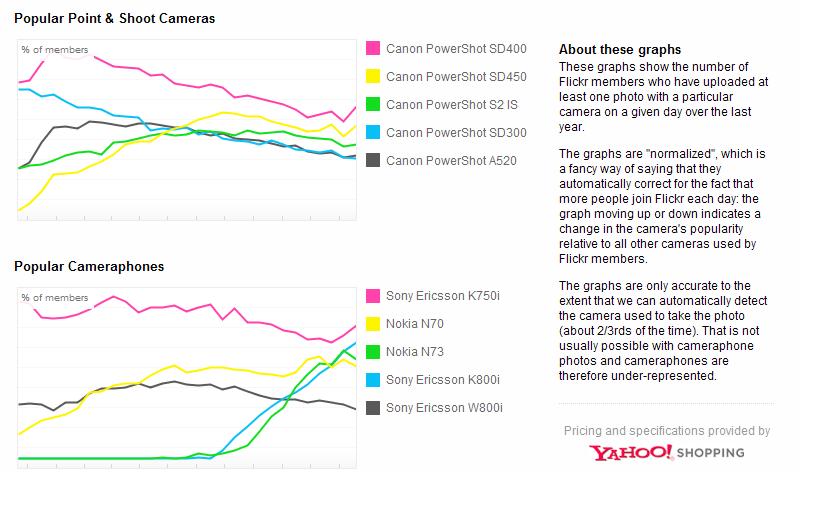
Flickr has found an interesting way to leverage the data from their community of users. When pictures are uploaded to Flickr, meta-data about the camera used to take the pictures is uploaded along with the the photographs. Flickr is now providing this information for anyone to view, while using it to drive traffic to Yahoo shopping (as most of you know, Yahoo owns Flickr).


I like their innovative approach to reusing the data; however, Yahoo is not as good at Google about distinguishing between content and advertising.


For example, the main part of the camera page prominently displayed at the top shows a “Featured Model” camera, which is actually an advertisement. In tiny light gray letters under the feature, you'll find this small disclaimer: “Featured Model is a sponsored placement.” The idea is really cool, but credibility with users would be increased if Flickr / Yahoo flipped the approach to feature the content (which cameras are really being used) while still providing clearly delineated advertising from sponsors.

Monday, September 25, 2006

Using Wikis for Corporate Collaboration

I just posted an entry on my Intel Trends in Web 2.0 blog about how “Wikis can be a great collaboration tool for use internally within the corporate environment or externally for use with customers or clients.”

If you want to learn more benefits of using wikis and hear about how I have been recently using wikis for collaboration, please visit my Intel Trends in Web 2.0 blog.

Tuesday, August 29, 2006

Collaborative Journalism at Wired

According to Wired news,

In an experiment in collaborative journalism, Wired News is putting reporter Ryan Singel at your service.

This wiki began as an unedited 1,059 word article on the wiki phenomenon, exactly as Ryan filed it. Your mission, should you choose to accept it, is to do the job of a Wired News editor and whip it into shape. Don't change the quotes, but feel free to reorganize it, make cuts, smooth the prose, or add links -- whatever it takes to make it a lively, engaging news piece. (Quote from the Wired Wiki)

Ross Mayfield reminds us that collaborative journalism does not always go according to plan:

Last time someone tried this it was a disaster, but Wired News has boldly put an article about wikis into a Socialtext wiki for anyone to be a Wired editor. ... This is of course different from the LA Times experminent as there is a clearly stated goal. It will be interesting to at least watch. (Quote from Ross Mayfield's Weblog)

I am particularly interested in this experiment, since I am in the process of doing something very similar as part of an O'Reilly Media project. Danese Cooper and I are in the process of writing a book on the Art of Community, which will start as a wiki. We are taking a similar approach by writing an initial first draft of the chapters, posting them to the wiki, and allowing the community to be our editors / collaborators on the project. We are still working on the details, but I hope to learn from the Wired news experiment.

On a related note, I couldn't help making a couple of edits to the Wired Wiki. This should be fascinating to watch.