Showing posts with label community. Show all posts

Tuesday, March 13, 2007

Open vs. Controlled Knowledge at sxsw

I attended the Open Knowledge vs. Controlled Knowledge panel this morning, and Gil Penchina, CEO of Wikia, made a really good point. Robert Capps from Wired had just been talking about how vandalism has been a big issue for Wired whenever they open something up for community contribution. Gil's point is that if things have been tightly controlled and are suddenly opened up as a free-for-all, you can end up with what he called “principal for a day” mentality where the community wants to change everything and really mess with the people who have been in control for so long. At Wikia, since it has been completely open from the beginning, they have seen less vandalism. The Wikia community feels ownership for the content: they watch the content, monitor changes, and make immediate corrections when things go wrong because they have a vested interest and feel ownership for the content.

Gil also pointed out that not everything should be transparent. At Wikia, the content is open, but the bathrooms still have doors and walls – there are some things that people want to see and other things they do not need or want to see.

From my perspective, this balance is important. Too far in either direction (open or closed) can create problems within the community, and a drastic shift in the balance between open / closed can also result in issues. Achieving and maintaining this balance within a community can be a difficult and tricky process, but it seems to be better to err on the side of open rather than closed.

Saturday, March 10, 2007

Thoughts on Anonymity and Identity in Communities from SXSW

I just listened to an interesting panel at sxsw on World Domination via Collaboration. One of the many great conversations during this discussion related to anonymity in communities. One panelist allows anonymous comments on her blog because she wants to know what people really think, even if she don't like it or agree with it. Another panelist mentioned Slashdot's use of anonymous coward, which highlights the fact that people value comments more from people who share a name and identity. I also allow anonymous comments on my blog (with captcha and other spam filters). Some trolls hide behind anonymity to say nasty things, but I have been lucky so far to only have a few of those comments. I find that the vast majority of people commenting will chose to share a name or other identity, but I am not comfortable forcing it on people. I prefer to have people share an identity because they want to, not because it is required in order to leave a comment. Like many people, I value the comments from people who associate their comments with an identity over those who choose to remain anonymous.

The panel members talked about how people in a community can be anonymous from the standpoint of not sharing a real name / real identity, but having a log in and identity on the site. This is a better solution from a community perspective where people tend to interact together over a longer period of time. Community members get to know each other based on the site identity. I have noticed this recently with my interactions on Jyte. Some people share a real name, others share some other identity, but you get to know these people based on this identity whether it is an “anonymous” identity or a “real world” identity. Jyte uses OpenID, which is a great way to facilitate identity management within a community, since it gives people control over their identities and allows them to use their identity (or multiple identities) across sites.

I am looking forward to more really great sessions at sxsw this weekend!


Sunday, December 10, 2006

O'Reilly's New Compact Definition of Web 2.0

Web 2.0 has always been one of those nebulous concepts that has been difficult to concisely define. Each person seems to have a slightly different idea about what is and is not web 2.0. Tim O'Reilly's original essay, What is Web 2.0, was quite lengthy, and he is now trying to define web 2.0 using a short, easy to remember definition:

Web 2.0 is the business revolution in the computer industry caused by the move to the internet as platform, and an attempt to understand the rules for success on that new platform. Chief among those rules is this: Build applications that harness network effects to get better the more people use them. (This is what I've elsewhere called "harnessing collective intelligence.") (Quote from Tim O'Reilly on O'Reilly Radar).

I am not sure that this is a business revolution as much as it is a consumer revolution that businesses can take advantage of by building “ applications that harness network effects to get better the more people use them.” I think the key to web 2.0 is how the expectations of the users are changing. Only a few years ago, most consumers saw the Internet as a passive medium, like radio and television, to be watched and enjoyed without any direct involvement. Many consumers now expect to be able to participate in the online environment by commenting, uploading, or participating in the content in a number of ways. I think that the key to web 2.0 is consumer driven participation and interactivity. Businesses need to understand this fundamental change and focus on building online participation into their business models.

I do think that O'Reilly has a great start toward a more concise definition of web 2.0.

Tuesday, December 05, 2006

Clearspace Collaboration Environment from Jive Software


I was lucky enough to get an early preview of Clearspace from the Jive Software team, a local Portland, Oregon company. They have just starting talking about Clearspace on the Jive Talks blog with a recent post from Sam Lawrence. They have not yet released details, and portions of the product were in varying stages of completion when I played with it, so I will not go into any specific details here.

What I will say is that this product is cool. It is intuitive to use and has a “web 2.0” feel to it with modern collaboration functionality built into the system from the beginning. None of the retrofit feel that older applications have when someone tries to cram a bunch of new technology into an ancient product. This will be a product to test drive when Jive launches it in early 2007:

“The idea for Clearspace actually came from our customers, who through their conversations with our sales, marketing, professional services and customer support teams had been asking for many different collaborative feature additions to Jive Forums and Knowledge Base. Some of these were very specific, others borrowed from a lot of the collaborative elements of completely different point solutions. At the beginning of last year we took a big step back and realized that the sum of what was being requested was a completely new, much more comprehensive product.

So, a year ago we faced very tough decisions. Up to that point we had planned to address our customer requests through a combination of improvements to our existing products and/or building a couple of totally new products. Our big decision was was whether to build three products or one. The more we talked about it the more we recognized the massive benefit that could be realized by a single, unified, flexible architecture– sort of like that quote from Lord of the Rings–”one ring to unite them all.” (ok, it was really “rule them all” but that’s too harsh.)” (Quote from Sam Lawrence on Jive Talks)

Wednesday, November 29, 2006

Firefox Crop Circle in Oregon Hits Google Maps

Way cool! Here is the Firefox crop circle created in rural Oregon after OSCON. Unfortunately, I wasn't involved in the crop circle, but I'm still waiting for our Cylon Raider from Foo to hit the maps.

Sunday, November 26, 2006

Mark Shuttleworth Invites OpenSUSE Developers to Join Ubuntu

The recent agreement between Microsoft and Novell has drawn quite a bit of criticism from the open source community especially with respect to the patent portions of the agreement. Mark Shuttleworth uses this as an opportunity to invite OpenSUSE developers into the Ubuntu community:

“Novell’s decision to go to great lengths to circumvent the patent framework clearly articulated in the GPL has sent shockwaves through the community. If you are an OpenSUSE developer who is concerned about the long term consequences of this pact, you may be interested in some of the events happening next week as part of the Ubuntu Open Week:

https://wiki.ubuntu.com/UbuntuOpenWeek

We are hosting a series of introductory sessions for people who want to join the Ubuntu community - in any capacity, including developers and package maintainers. If you want to find out how Ubuntu works, how to contribute or participate, or how to get specific items addressed, there will be something for you.

...

If you have an interest in being part of a vibrant community that cares about keeping free software widely available and protecting the rights of people to get it free of charge, free to modify, free of murky encumbrances and “undisclosed balance sheet liabilities”, then please do join us.” (Mark Shuttleworth, here be dragons)

Mark's pragmatic response is certainly a more productive reaction to the issue than what I have seen elsewhere. I also suspect that Mark is on to something: Novell will probably lose quite a few good community members as a result of this action.

Web 2.0 Reality and Hype

I have a huge amount of respect for Bill Thompson, but his recent article in the Register Developer takes an overly harsh view of web 2.0. Admittedly, the term is now associated with an amount of hype not seen since the last tech bubble of the dot com era; however, web 2.0 ideas and technologies also have strengths: an architecture of participation facilitating user generated content, an increase in citizen journalism, improved user interfaces, and more. Bill Thompson seems to be willing to forgo these benefits and dismiss the technologies that make them possible as pure buzz and hype with no substance.

“Now we must decide whether to put our faith in Ajaxified snakeoil or to look beyond the interface to distributed systems, scalable solutions and a network architecture that will support the needs and aspirations of the next five billion users.

...

Over it all stretches the 'Web 2.0' banner, a magical incantation that will bring attention, funding and respect to any programmer able to weave a little Ajax into their interface. It seems that it only takes a browser that can interpret JavaScript and a server that will let a page call for packaged data through XMLHttpRequest and we can have all the benefits of distributed systems without the need to write too much code or rethink the way that the different components of a service communicate with each other.

If Web 2.0 is the answer then we are clearly asking the wrong question, and we must not be fooled by the cool sites and apparently open APIs. Most of the effort is – literally – window dressing, designed to attract venture capitalists to poorly-considered startups and get hold of enough first-round funding to build either a respectable user base or enough barely runnable alpha code to provide Google or Yahoo! with yet another tasty snack. We need to take a wider view of what is going on.

...

Web 2.0 marks the dictatorship of the presentation layer, a triumph of appearance over architecture that any good computer scientist should immediately dismiss as unsustainable.” (Bill Thompson, Reg Developer)

A good architecture is always important, but we can also have a great user interface and user experience along with it. Shelley Powers does a great job of putting this in perspective:

“I'm not sure who is touting Ajax as a replacement for distributed systems. If that were so, I wouldn't be writing a book on the Ajaxian technologies. Ajax is nothing more than a way to create a user interface that's simpler, quicker, and easier to work with then more traditional web pages. It's handy, its helpful, but it's also limited and most who work with it understand this is so. Unless Mr. Thompson believes that user interfaces aren't needed in his distributed utopian environment, I don't see the technologies going away. Nor do I see them interfering with distributed development.

...

Even his dismissal of JavaScript and XML makes little sense. According to Thompson, we cannot rely on Javascript and XML since they do not offer the stability, scalability or effective resource discovery that we need. Need for what? XML is a standardized markup, a syntax, a way of organizing data so that multiple application can access the data without having to come to some kind of agreement as to format. It's use in syndication, for instance, has led to an explosion of communication; a version of which forms the basis of this page–in what way does this not scale, lead to resource discovery, or demonstrate instable behavior?

As for JavaScript, it's almost as old as Java, and is considered the most commonly used programming language in use today. It is not a replacement for Java, nor is Java a replacement for it. If I wouldn't think of using JavaScript to build a distributed system, neither would I consider using Java and EJB to validate my form data, or provide for live commenting. Apples and oranges.” (Shelley Powers on Mad Techie Woman)

No single technology (or even a group of technologies, like AJAX) will ever be the “perfect” solution to every problem. We need to keep this in perspective and focus on using the right technology for each job. Dismissing whole categories of technologies as hype without acknowledging that they have legitimate uses is not a productive discussion. It is black and white argument in a very gray world.

Tuesday, November 21, 2006

Web 2.0, Data Gathering, and Flickr

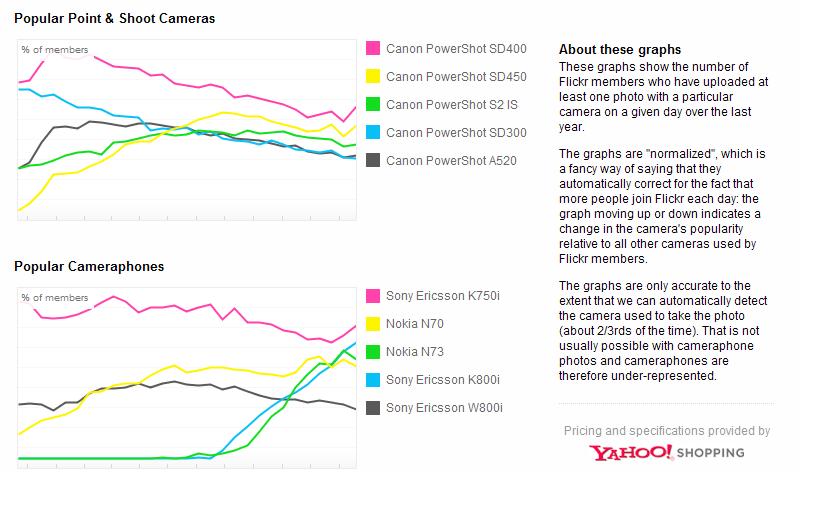
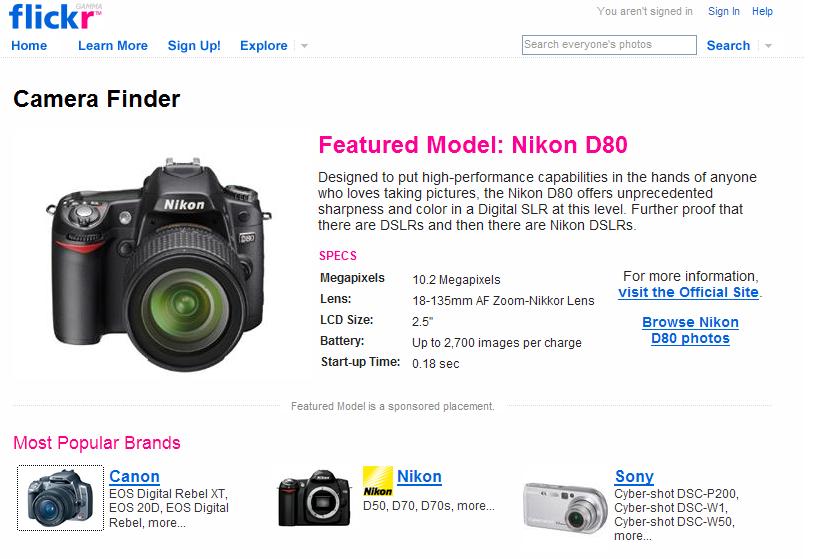
Flickr has found an interesting way to leverage the data from their community of users. When pictures are uploaded to Flickr, meta-data about the camera used to take the pictures is uploaded along with the the photographs. Flickr is now providing this information for anyone to view, while using it to drive traffic to Yahoo shopping (as most of you know, Yahoo owns Flickr).


I like their innovative approach to reusing the data; however, Yahoo is not as good at Google about distinguishing between content and advertising.


For example, the main part of the camera page prominently displayed at the top shows a “Featured Model” camera, which is actually an advertisement. In tiny light gray letters under the feature, you'll find this small disclaimer: “Featured Model is a sponsored placement.” The idea is really cool, but credibility with users would be increased if Flickr / Yahoo flipped the approach to feature the content (which cameras are really being used) while still providing clearly delineated advertising from sponsors.

Saturday, November 18, 2006

Moving on to a New Gig (Compiere)

Friday was my last day at Intel. Changing jobs always brings mixed feelings: excitement about starting a new job combined with the difficult feelings associated with leaving so many great co-workers and friends. Intel has been a great company, and I have learned so much over the past six+ years; however, a few weeks ago, I made the difficult decision to leave Intel to return to my open source roots.

I have just joined Compiere as their new Director of Community and Partner Programs where I will be working in a small, start-up environment for the first time in my career. Compiere is an open source ERP/CRM software company, and I will be responsible for managing the relationship between Compiere and their open source community while also managing some partner relationships and programs. I am excited to be working in open source again, and Compiere has some really interesting technology that could make a real difference within the enterprise environment.

This is a great opportunity for me, and I am thrilled to be joining the Compiere team.

Saturday, November 11, 2006

Why Attend Conferences? AKA Time for a Change

The buzz around the Web 2.0 Summit this week got me thinking about why we attend conferences in today's world of near constant connectivity and information overload. I remember listening to TWIT sometime around CES when Dvorak talked about how he was “virtually”attending CES. He had decided to skip the travel and follow the news coverage virtually rather than physically attending the event. With thousands of other journalists in attendance, Dvorak decided that having one more technology reporter on the show floor was not a good use of his time.

Before every company had a website, before bloggers, and before RSS readers, we attended conferences because conferences were the primary mechanism for learning about new technologies. Now, we can read our favorite blogs, newspapers, and trade magazines from the comfort of our couches in our pajamas with wireless laptops. With so many great summaries of every conference appearing online and bloggers posting live updates whenever someone important sneezes, the need to attend conferences to gather information is greatly diminished.

Historically, we also attended conferences to hear the experts speak on relevant topics; however, podcasts are making conference keynotes, sessions, and even panels less relevant. I admit to being a podcast addict. I typically subscribe to more podcasts than any one human being could possibly process, but it does give me the opportunity to pick and choose based on my current interests. I regularly hear interviews with open source experts on FLOSS Weekly and the O'Reilly Foo Casts, web 2.0 experts on TalkCrunch, and a little bit of everything related to the tech industry from TWIT and PodTech. I do not need to attend a big conference to hear the experts and their latest ideas about technology.

Conferences have also become a mechanism for corporate PR and product launches designed to capitalize on the topical buzz around the time of a big conference, but in reality, the press releases and launches tend to get lost in the noise with dozens and even hundreds of press releases crammed into just a few short days. This is also a holdover from the days when people attended conferences to learn about the next new thing, and corporate types have the conference press release machine in motion.

I am not saying that we should stop attending conferences; however, our reasons for attending have changed over time. I currently attend conferences mainly to hold meetings with customers / partners and network with other smart people to generate new ideas and new ways of thinking about the tech world. The customer meetings and networking usually happen outside of the traditional conference format as lunches, dinners, and informal hallway conversations. Typically, I can learn more by spending 10 minutes in a hallway chat with someone than I can learn in an hour long conference session. Conferences are a great way to gather a whole bunch of experts and those wanting to learn more about a topic together in one place to facilitate learning and the sharing of new ideas and thoughts.

I am starting to wonder if technology conferences are due for a change. Maybe fewer talking heads and fewer keynote sessions with a larger number of small discussion groups giving people an opportunity to share ideas. I am also becoming a fan of the “un-conference” format popularized by FooCamp and BarCamp, which provide a framework for a conference where intimate discussions can be more easily organized; however, I do not know how well the un-conference format would scale when you get larger numbers of attendees. I recently had a discussion at a party with Identity Woman aka Kaliya who is an advocate for a hybrid approach like the un-conferences, but with a little more structure to keep people on track.

I am not quite sure if there is an “answer” to the conference dilemma, but I suspect that the time is right for a broader change in how we organize and attend technology conferences.

Sunday, October 29, 2006

The MySpace Migration aka The Death of MySpace?


The Washington Post claims that “In Teens' Web World, MySpace Is So Last Year.”

"I think it's definitely going down -- a lot of my friends have deleted their MySpaces and are more into Facebook now," said Birnbaum, a junior who spends more time on her Facebook profile, where she messages and shares photos with other students in her network.

From the other side of the classroom, E.J. Kim chimes in that in the past three months, she's gone from slaving over her MySpace profile up to four hours a day -- decorating it, posting notes and pictures to her friends' pages -- to deleting the whole thing.

"I've grown out of it," Kim said. "I thought it was kind of pointless."

Such is the social life of teens on the Internet: Powerful but fickle. Within several months' time, a site can garner tens of millions of users who, just as quickly, might flock to the next place, making it hard for corporate America to make lasting investments in whatever's hot now.

The high school English class cites several reasons for backing off of MySpace: Creepy people proposition them. Teachers and parents monitor them. New, more alluring free services comes along, so they collectively jump ship. (Quote from The Washington Post)

I can attest to the creepiness. I have received “friend” requests from all sorts of creepy people to the point where I cringe when getting ready to look at a request to see whether I know the person in real life, and I do not spend much time on the site. Younger girls may be even less equipped to handle these situations, and by spending more time on the site, they probably see many more of these requests than I do.

With all of the press around MySpace drawing parents, teachers, and prospective employers to view MySpace pages, young people must feel like they are under a microscope instead of hanging out with friends in a casual environment. As a teen, this might drive me to switch to another social networking site.

It will be interesting to see if Facebook continues to grow to become the dominant social networking site for teens / college students. It will also be interesting to see if Facebook users entering the professional workforce after college continue to use it or whether they migrate to another social networking site or give up the idea of social networking entirely (doubtful).

Teens have always been a fickle crowd. What is hot one day becomes uncool the next. Cynthia Brumfield compares the switching behavior of teens in social networking to television shows:

This meteroic rise and ultimate dwindling puts me in mind of hit TV shows. At their best, hot TV shows can dominate the cultural consciousness, generating huge (although that’s a relative term given the increasingly fractionalized) audiences and scads of ad revenue. If it weren’t for the artificially (i.e. regulation-induced) complex nature of the TV programming marketplace, with most producer profits earned in the back-end during syndication, a hit TV show that soars and then fizzles (remember “Twin Peaks”) could be a very profitable enterprise. In other words, a TV show that becomes a hit but doesn’t stay a hit could make lots of money.

Moreover, hit TV shows can become the springboard for more money-making ventures, even when they fade (“Cheers” spawned “Frasier”). The trick for any given TV production company is to keep the creativity and business ingenuity going, and not rest on past successes.

The same thing holds true for hot web properties such as MySpace. MySpace is bound to fade—the Internet is a very contestable market, as economists say, and rivals can step in at any time, particularly for something as technically simple as social networking. But there’s little doubt that News Corp. has a chance to make money with MySpace while it’s still popular and the company is doing everything it can to exploit MySpace while it’s still warm.

The trick for News Corp., or Google, which just paid $1.65 billion for YouTube (another site highly vulnerable to competition) or any other entertainment business on the Internet is figuring out where they go from here. They can’t just sit back and expect to rake in the dough, hoping that their hit sites stay hot. They have to move forward and leverage their hits to create the next big thing. (Quote from Cynthia Brumfield on the IP Democracy blog)

This could be a sign that MySpace is fading into oblivion; however, I am not ready to predict the death of MySpace yet. Despite the migration of some teens to other sites, MySpace still has quite a bit of momentum. I expect that MySpace can continue to ride this momentum for a while before heading into a death spiral. It is also conceivable that News Corp could find a different, and profitable, niche for MySpace around music, other age groups, or some other aspect of social networking.

Tuesday, September 12, 2006

The Great Encyclopedia Debate: Wikipedia vs. Britannica

The Wall Street Journal today contains an interesting debate between Jimmy Wales, Wikipedia's founder and chairman of the Wikimedia Foundation, and Dale Hoiberg, senior vice president and editor in chief of Encyclopaedia Britannica. Here are a few of the most interesting snippets:

Wales: “We believe that encyclopedias should not be locked up under the control of a single organization, but a part of the healthy dialog of a free society.”

Hoiberg: “But there is little evidence to suggest that simply having a lot of people freely editing encyclopedia articles produces more balanced coverage. On the contrary, it opens the gates to propaganda and seesaw fights between writers with different axes to grind. Britannica draws from a community, just as Wikipedia does. Ours consists of more than 4,000 scholars and experts around the world who serve as our contributors and advisers. ... While Wikipedia may welcome scholars, all the reports I've seen suggest that most of the work is done by individuals who, though very dedicated, have little or no scholarly background.”

Wales: “Artificially excluding good people from the process is not the best way to gather accurate knowledge. Britannica has acknowledged the value of having multiple contributors, although of course because they are proprietary rather than freely licensed they would have a very hard time attracting the kind of talent that we have. The main thrust of our evolution has been to become more open, because we have found time and time again that increased openness, increased dialog and debate, leads to higher quality. I think it is a misunderstanding to think of "openness" as antithetical to quality. "Openness" is going to be necessary in order to reach the highest levels of quality. Britannica has long been a standard bearer, and they have done a fine job within their model. But it is time to work in a different model, with different techniques made possible by new technologies but the same goals, to reach ever higher standards.”

Hoiberg: “I can only assume Mr. Wales is being ironic when he says Britannica would have a hard time attracting the kind of talent that Wikipedia has. Britannica has published more than a hundred Nobel Prize winners and thousands of other well-known experts and scholars. Contrary to Wikipedia, Britannica's contributor base is transparent and not anonymous.”

Wales: “We have spoken openly about some of the challenges and difficulties we face at Wikipedia. Not long ago, you suffered some bad publicity due to errors in Britannica. Have you considered changing your model to allow quick, transparent responses to such criticisms as a way to achieve a higher quality level? “

Hoiberg: “I must point out that Mr. Wales's inclusion of two links in his question to me, one to Wikipedia itself, is sneaky. I have had neither the time nor space to respond to them properly in this format. I could corral any number of links to articles alleging errors in Wikipedia and weave them into my posts, but it seems to me that our time and space are better spent here on issues of substance.”

Wales: “Sneaky? I beg to differ. On the Internet it is possible and desirable to enhance the understanding of the reader by linking directly to resources to enhance and further understanding.”

Quotes from the Wall Street Journal

We have not resolved the great encyclopedia debate, and we probably never will. Both models have their strengths and weaknesses, and as a result, both can probably learn from the other, which is why the title of the WSJ article, Will Wikipedia Mean the End Of Traditional Encyclopedias?, is so misleading. The title implies a black and white solution to an increasingly gray world . We can have both a community encyclopedia and a traditional encyclopedia without having to choose one over the other. This gray world that we live in has enough room for both approaches to continue and thrive.